Feature · 6 September 2026
Surviving the Kalahari: The Remarkable Resilience of the San People
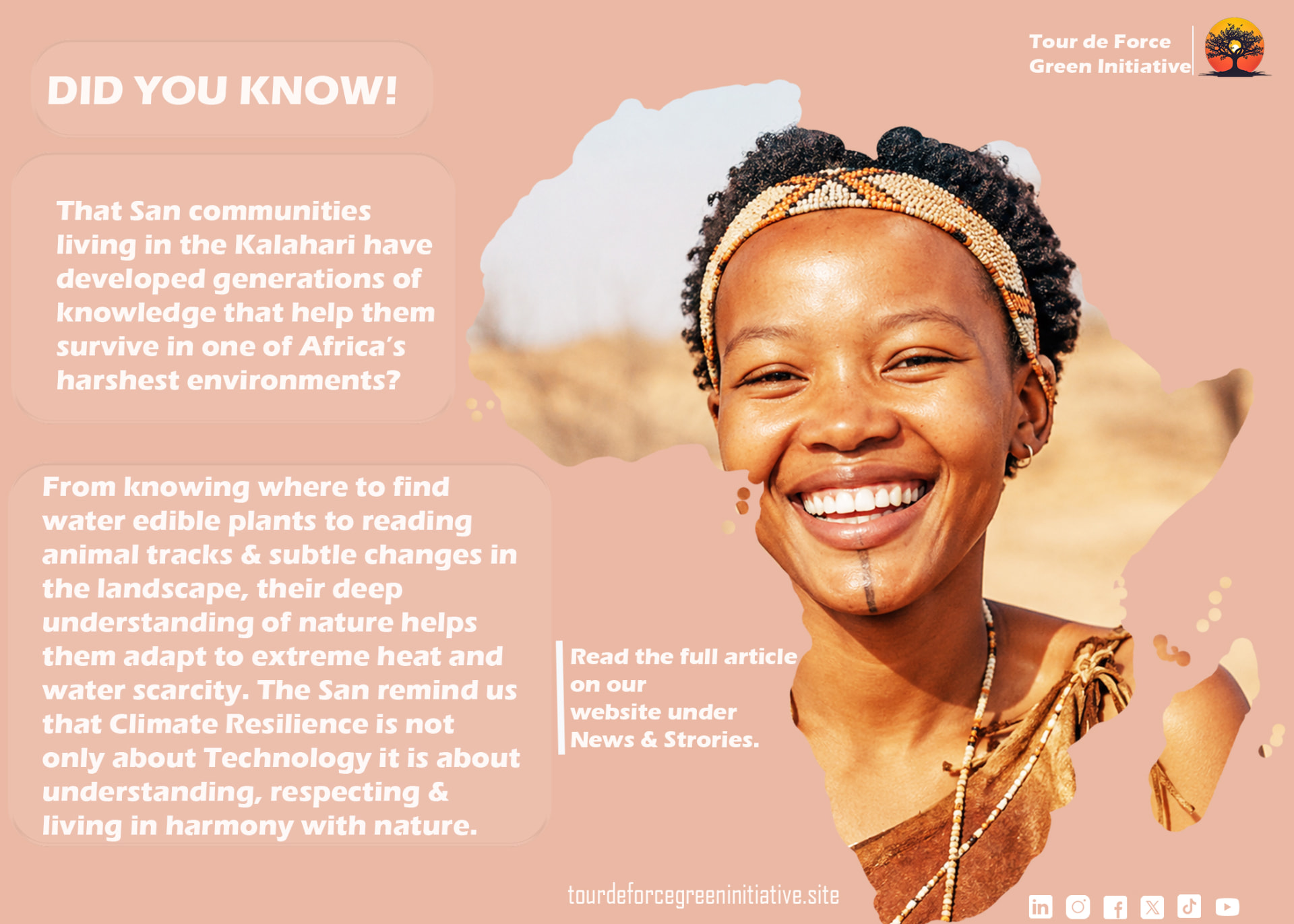
Where the horizon shimmers with heat and rain can stay away for months, the San people of the Kalahari have built a way of living that is nothing short of extraordinary. Often described as among the oldest continuous cultures on earth, the San are found across Botswana, Namibia, Zambia, Zimbabwe, Angola and South Africa. The Kalahari is not simply the land they occupy. It is a library they have been reading for thousands of years.
The conditions are unforgiving. Daytime temperatures can climb beyond forty degrees, nights can turn surprisingly cold, surface water is rare and rainfall is unreliable. In such a place, survival is not luck. It is knowledge, discipline and an intimate relationship with the environment.
Water is the first test. Where others see dry sand, the San know the plants whose roots hold moisture, the melons that carry water through the dry season, and the low points in the land where moisture lingers beneath the surface. Traditional techniques such as drawing water from damp sand through a hollow reed, and storing water in ostrich eggshells sealed and buried for later use, turn scarcity into security. Nothing is wasted, and nothing is taken carelessly.
Food follows the same discipline. Gathering supplies the greater part of the diet: tubers, roots, nuts, berries and melons collected with a precise sense of what is ripe, what is safe and what must be left to regrow. Hunting is patient rather than aggressive. The persistence hunt, in which trackers follow an animal in the heat until it tires, depends on reading tracks, droppings, bent grass and wind. It is a skill of observation as much as endurance, and it is shared: what is caught is distributed across the group.
Behind these practices lies a vast body of environmental knowledge. The San read seasons in the flowering of a shrub, weather in the behaviour of insects and birds, and danger in a single disturbed footprint. Hundreds of plant species are known for food, medicine, poison, cordage and shelter. This knowledge is carried in stories, songs, dance and daily teaching, passed from elders to children long before any of it was written down.
That knowledge has never been only about survival. It has helped neighbouring communities adapt too, informing how people find water, treat illness, manage grazing and read the signs of a difficult season ahead. Because San life depends on the land recovering, restraint is built into the culture. Areas are rested, harvests are limited, and species are protected by custom. It is conservation practised long before the word existed.
Today that balance is under pressure. Rainfall patterns are shifting and droughts are becoming more severe. Access to traditional lands has narrowed through fencing, land allocation, mining and the expansion of protected areas that sometimes exclude the very people who cared for them. Modernisation, formal schooling in unfamiliar languages, and the pull of settlements and wage labour risk breaking the chain through which knowledge is passed. When an elder dies without a listener, an entire archive is lost.
This is why indigenous knowledge belongs at the centre of climate conversations, not at the margins. Climate resilience is not only satellites, sensors and finance. It is also the understanding of how a specific landscape behaves, held by the people who have lived with it longest. Combining that understanding with modern science produces solutions that actually fit the places they are meant to serve.
The San remind us that resilience is a relationship. Protect nature and it will carry you. Listen to the communities who have kept that relationship alive, and their knowledge becomes a shared inheritance rather than a disappearing one. Safeguarding the Kalahari and safeguarding San knowledge are, in the end, the same act.
Written by: Matongo Miles Munyama, Tour de Force Green Initiative